Best Body Doubling Apps for ADHD: 6 Free Options Compared (2026)
Stan · · 13 min read
6 body doubling apps for ADHD compared: which are free, which work online in your browser, what Dubbii and the rest really cost, and who each fits. Focusmate, Flow Club, Flown and more.
The best body doubling apps for ADHD are Focusmate for free one-on-one video sessions, Dubbii for phone-based live and recorded hosts, Flow Club and Deepwrk for hosted groups, Flown for a generous free tier, and BrightMind for body doubling by phone with an AI that calls you in the app. Focusmate and Flown are genuinely free and run in your browser with no download; the rest are free trials or phone apps.
You've got the tab open. You know what you're supposed to be doing. And you've been not-doing it for the last forty minutes, alone, getting quietly worse at it.
Body doubling is the trick where you do the task next to another person who's working on their own thing, and their presence somehow gets yours moving. Apps turn that into something you can summon on demand instead of texting a friend and hoping they're free. This post compares the six worth knowing, free tiers and real prices included.
Full disclosure up front: one of the six is mine. I'll flag it clearly and tell you where it's a worse fit than the others, because a list that pretends its own product wins everything is useless to you.
Which body doubling apps are best?
Here's every app side by side, with each fact checked on the vendor's pages or store listings on November 18, 2026, in US dollars. The "Free?" column separates real free plans from trials, and the browser column shows which ones work online with nothing to install. Narrow the field here, then confirm prices at the source before you pay.
| App | Free? | Works in a browser? | Paid price | Presence | Best for |
|---|---|---|---|---|---|
| Focusmate | Yes, up to 3 sessions/week | Yes, nothing to install | $8/mo yearly, $12/mo monthly | Live human, 1-on-1 | One-on-one accountability |
| Dubbii | Trial only, 3 days | No, iOS and Android app | $9.99 or $49.99 subscriptions | Live hosts + recorded videos | Phone-first chores and admin |
| Flow Club | Trial only | Yes | $40/mo, $400/yr | Live human, hosted group | Energized by a hosted room |
| Deepwrk | Trial only, 7 days, no card | Yes | $19/mo, $12/mo yearly | Live human, hosted group | ADHD-specific community |
| Flown | Yes, 4 sessions/mo + Fridays | Yes | $25/mo, $19/mo yearly | Live human, facilitated group | A wider focus practice |
| BrightMind | Yes, 30 min of calls/week | No, iOS and Android app | $12.99/mo, $99.99/yr | AI voice call in the app | Getting unstuck before you start |
Are there free body doubling apps?
Yes, and two of them are free with real people. Focusmate gives up to three live one-on-one sessions a week, and Flown's free plan includes four community sessions a month plus Friday sessions. BrightMind's free plan includes 30 minutes of calls a week with an AI. Dubbii, Flow Club and Deepwrk run free trials instead of permanent free plans.
That split matters more than it looks. A free plan is something you can lean on every week for as long as you like. A trial is a few days to decide whether to pay: three for Dubbii's new eligible subscribers, seven for Deepwrk, with no card needed. If money is the constraint, build your week around Focusmate or Flown and treat the trials as experiments.
Free body doubling websites (online, no download)
If you'd rather body double online than install anything, four of the six are websites: Focusmate, Flow Club, Deepwrk and Flown all run in the browser on any computer. Only Focusmate and Flown are free beyond a trial. Dubbii and BrightMind are the two native apps, for iPhone and Android, with no web version.
Two free extras are worth knowing. StudyStream's focus rooms, where you study alongside strangers online, include up to an hour a day on the free plan, as of November 2026. And if you want a body double with no sign-up at all, free "study with me" and "work with me" videos on YouTube cost nothing and ask for nothing. The free, no-install options in our Focusmate alternatives guide cover those, plus Discord study servers, in more detail.
What do body doubling apps do?
A body doubling app puts you in a session, live or recorded, with someone else working alongside you so your brain borrows their structure. You both do your own tasks. The other person's presence creates accountability and a gentle nudge to keep going, which is the mechanism that makes starting easier.
If you want the full concept, the body doubling guide covers why it works. The Cleveland Clinic describes body doubling as "doing a task or project while in the presence of one or more people," and frames it as external executive functioning, propping up the focus that ADHD makes hard to generate alone (Cleveland Clinic, 2025). Apps just make that presence reliable. You don't have to find a willing human at 9pm on a Tuesday; you open the app and someone's there.
The category splits into three shapes. Live one-on-one matching pairs you with a real stranger for a set block. Live group rooms put a host and a handful of people in a session together. Recorded presence lets you follow along with a video or a quiet room. Each suits a different brain, which is the point of comparing them. All of them are virtual body doubling, the remote version of a friend at the kitchen table, and the body doubling guide weighs in-person against virtual if you're unsure which you need.
Do body doubling apps actually work?
For many people with ADHD they help, especially with starting, but the evidence is thin. A 2026 research roadmap (a preprint) notes that research on body doubling and ADHD is "limited to only a small number of papers and master's theses," with a gap in studies of whether and how it works. Most support comes from clinicians and users.
What we do know points the same way. Clinicians at the Cleveland Clinic describe body doubling as external executive functioning: another person's presence props up the focus and follow-through that ADHD makes hard to generate alone (Cleveland Clinic, 2025). CHADD is candid that there "hasn't been significant research to validate the benefits," and that body doubling doesn't work for everyone (CHADD). And outside ADHD, research on digital health programs finds that people stick with them more when a human is involved, because being accountable to someone supportive changes behavior (Mohr and colleagues, 2011). Body doubling apps package that accountability so you can get it on demand.
So treat it as a cheap experiment, not a treatment. Try two or three free sessions on the tasks you freeze on most, and judge by one thing: did you start? If a live stranger helps, Focusmate or a group room is your tool. If the moment before the session is the problem, a call that reaches you first, like BrightMind's, may fit better. And if nothing changes after a week, that's useful information too.
How did we pick these apps?
We picked for honesty over hype: real pricing pulled from each vendor's own pages, a clear note on whether the presence is human or recorded, and a frank line on who each app is wrong for. ADHD apps love to promise transformation. We care more about whether the free tier is actually usable and what you pay when it isn't.
Every price and platform fact below was checked on the company's own site or app store listing, most recently on November 18, 2026. Pricing for these apps moves, so each claim is hedged with "as of this writing." If a number matters to your decision, confirm it at the source before you pay.
We're also not pretending body doubling is a cure. It's a well-liked strategy with a lot of clinical support and not much large-scale research behind it yet (CHADD). It helps a lot of people start tasks they'd otherwise freeze on, and does nothing for some. The right move is to try a free session and see if your nervous system responds, not to overthink it into another form of paralysis.
The apps
The six apps below cover every shape of body doubling: live one-on-one matching, hosted group rooms, recorded follow-along, and a voice assistant, each rated on its free tier, real price, and who it's wrong for. Five are built around other humans. The last, mine, is an AI you talk to, placed last so the comparison stays fair.
Focusmate
Focusmate pairs you with one real person for a live video session where you both state a goal, mute, work, and check in at the end. It's the most established name here and the default recommendation for anyone who wants accountability from an actual human without the awkwardness of a group.
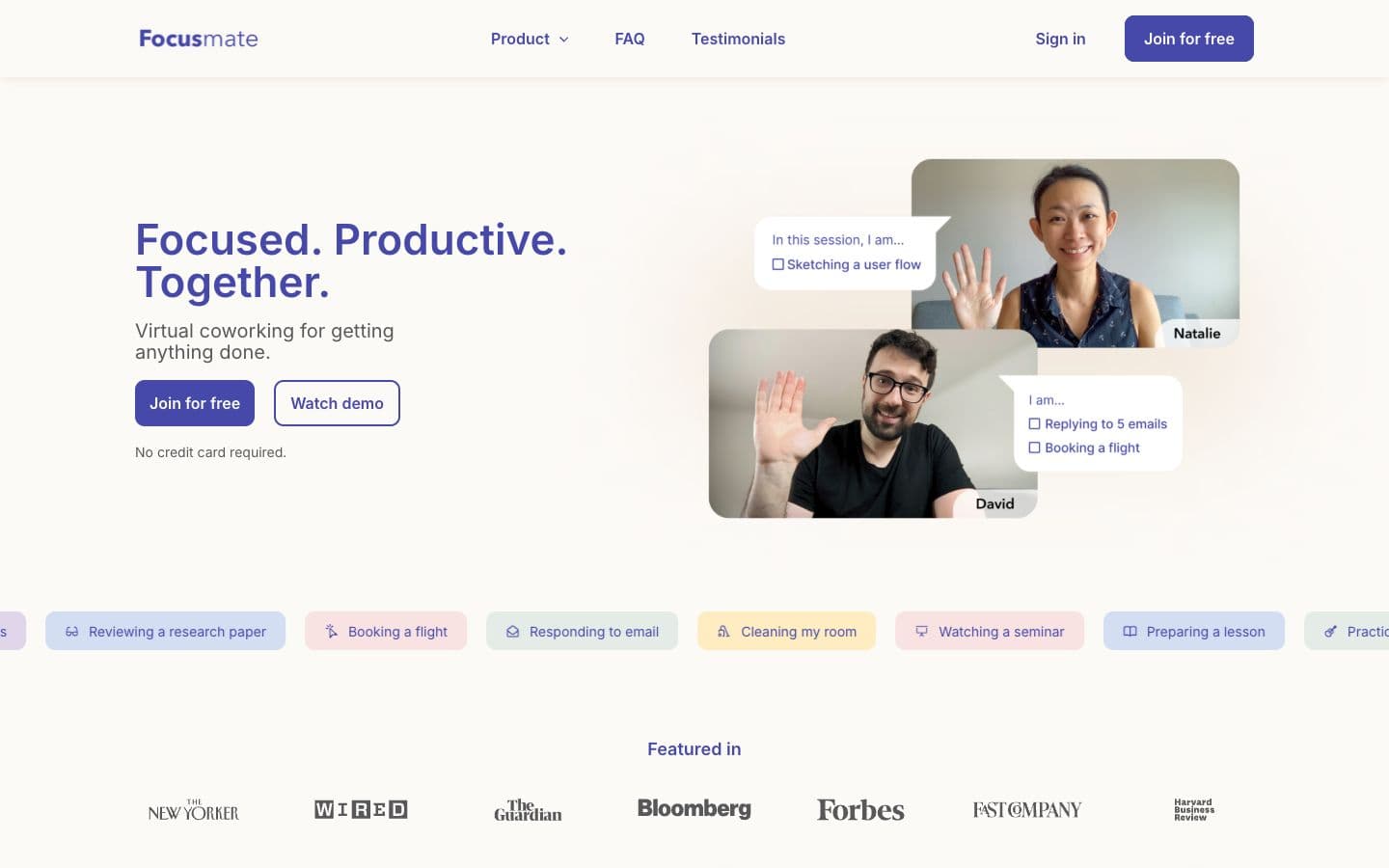 Focusmate homepage: "Focused. Productive. Together." with two people waving on video and their session goals
As of this writing, the free plan includes up to three sessions per week, and Focusmate Plus is $8 a month billed yearly or $12 a month billed monthly (focusmate.com/pricing). It runs entirely in the browser on desktop or mobile, with no app to download. Sessions come in 25, 50, and 75-minute lengths, and the partner is a community member, not a coach.
Reach for this if a single stranger expecting you is exactly enough pressure to start, without the awkwardness of a crowd. The catch is that it's video-first, so a bad-camera day becomes a barrier, and three free sessions a week runs out fast once it's your main way to work. If the camera is the dealbreaker, the Focusmate alternatives list covers camera-free options.
Dubbii
Dubbii is the phone-first option, built by the ADHD Love team. Instead of matching you with one stranger, it gives you live body doubling sessions with friendly hosts, which its store listing says run every three hours, around the clock, plus follow-along cleaning videos with hosts Rich and Rox, a Quiet Focus Room open 24/7, and gentle nudges for medication and chores.
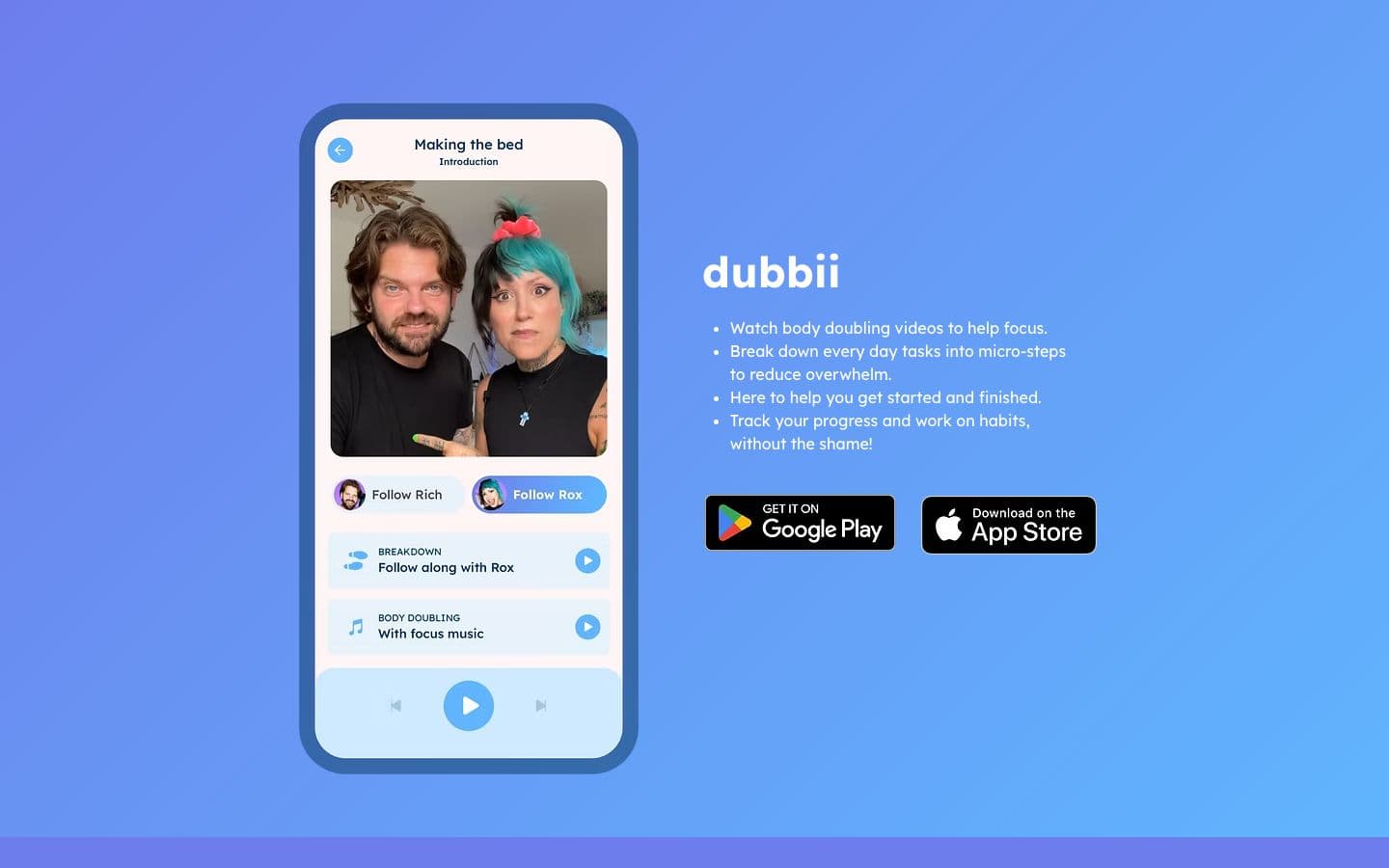 Dubbii homepage: a phone playing a "Making the bed" video with hosts Rich and Rox, beside a list of features and store buttons
It's a native app for iPhone, iPad and Android, which sets it apart from the browser-based co-working tools, and it's well liked: 4.8 stars from 781 ratings on the US App Store and over 100,000 downloads on Google Play as of November 2026 (Dubbii, App Store and Google Play).
It's the pick for working through everyday chores and admin on your phone, when a warm host and a room of other "dubbers" sit better than a single stranger on video. The honest limit: the follow-along videos are presence, not accountability, because nobody's actually waiting on you, and the live rooms are groups, so if one specific person expecting you is what gets you moving, Focusmate fits better.
What does the Dubbii app cost?
As of November 2026, Dubbii is free to download, and new eligible subscribers get a 3-day free trial. After that it's a subscription: the US App Store lists two options, at $9.99 and $49.99, and Google Play shows in-app purchases from $9.99 to $49.99. Neither listing says which price covers which billing period, so check inside the app.
Two more things worth knowing before you search for a discount. Dubbii's release notes from a July update told users that subscription prices were changing, so older prices you find quoted on review sites may be out of date. And there's no web version: you get Dubbii from the App Store or Google Play, both linked from dubbii.app. If you want body doubling that's free for good rather than a trial, Focusmate's free plan or Flown's free tier is the cheaper route.
Flow Club
Flow Club runs live, host-led group sessions where everyone shares a goal, works through a focused block (usually around 50 minutes) with optional music, then debriefs at the end. The host and the ritual are the draw. It feels less like a silent room and more like a class with energy.
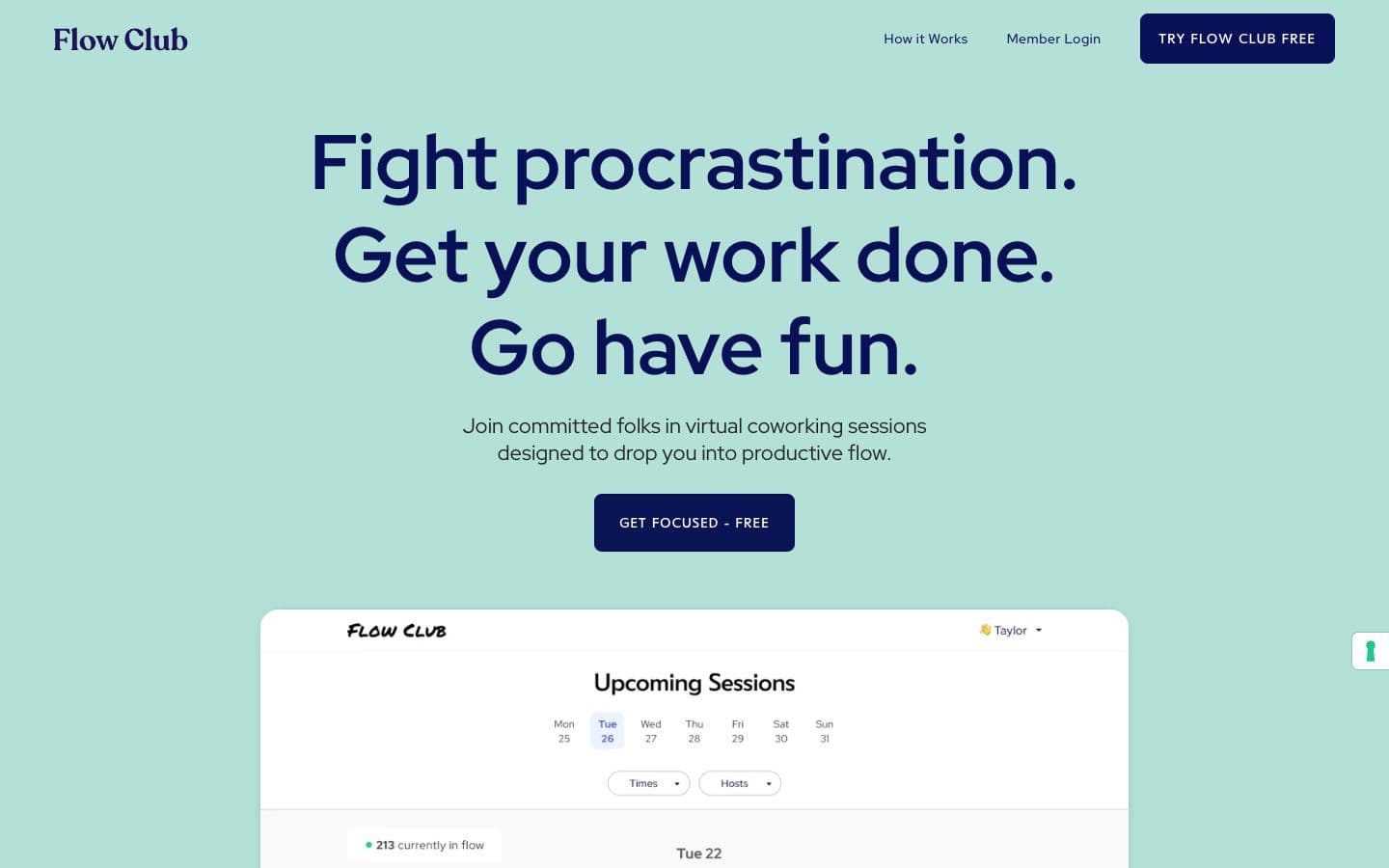 Flow Club homepage: "Fight procrastination. Get your work done. Go have fun." above a calendar of upcoming sessions
As of this writing, Flow Club offers a free trial and then runs $40 a month or $400 a year, with 50 percent off for students, non-profits, and qualified hosts (flow.club). It's browser-based, and you can keep your camera on or off, with chat-only sessions available if speaking isn't your thing.
This one's for people who are energized by a hosted group and don't mind paying a premium for it. It's also the most expensive option here by a wide margin, and the group format that some people love is what makes others want to hide. If a room full of strangers leaves you more drained than focused, this is the wrong door.
Deepwrk
Deepwrk is a co-working platform built specifically for adults with ADHD, running live host-led group focus sessions where members share goals, work on their own tasks, and debrief together. The pitch leans hard on community, connecting you with other people who get the executive-function struggle rather than a general productivity crowd.
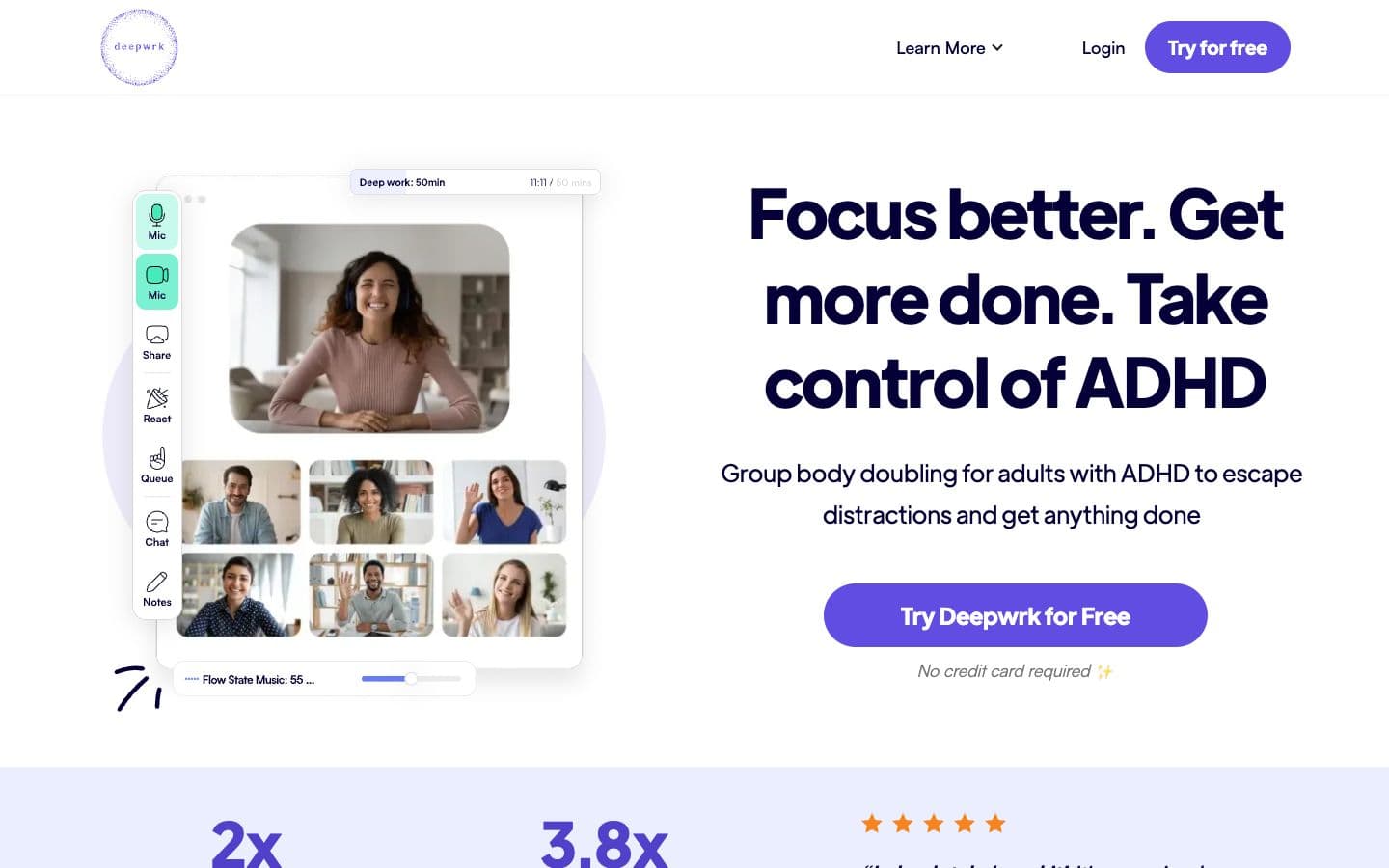 Deepwrk homepage: "Focus better. Get more done. Take control of ADHD" beside a video grid of people in a group session
As of this writing, Deepwrk costs $19 a month, or $12 a month if you pay annually, with a 7-day free trial that doesn't require a credit card (deepwrk.io). It runs in the browser at app.deepwrk.io. The sessions follow the familiar goal-work-debrief group structure.
Best for: people who want an ADHD-specific community and a hosted room at a friendlier price than Flow Club. There's no permanent free tier though, just the trial, so plan for a recurring cost, and like every group option here, the social format that helps some people overwhelms others.
Flown
Flown is a deep-work platform that wraps body doubling sessions (it calls them Flocks) together with facilitated focus blocks, plus extras like meditation, breathwork, and planning workshops. It's the broadest tool here, for people who want a whole focus practice rather than a single co-working room.
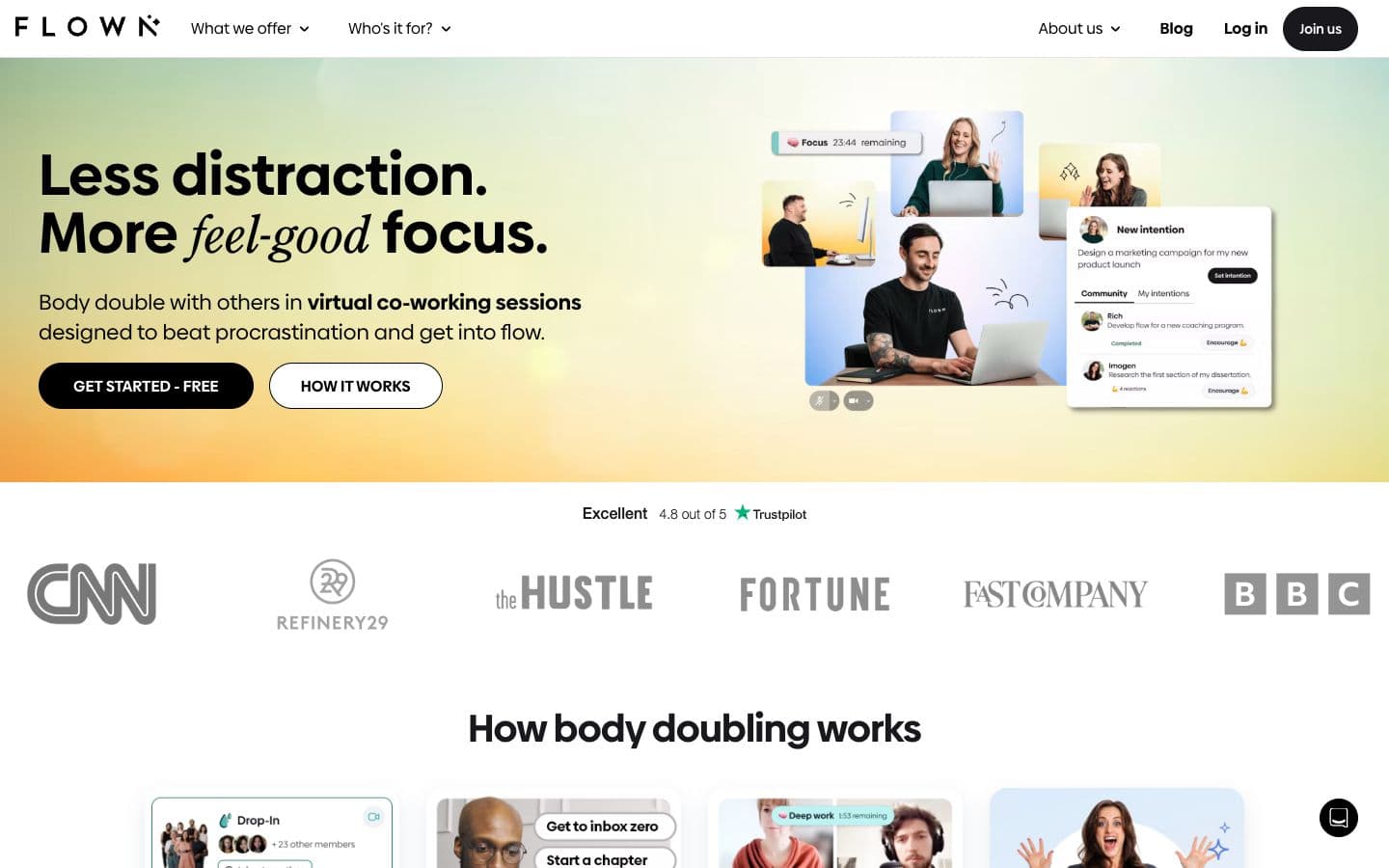 Flown homepage: "Less distraction. More feel-good focus." beside people working on video and a list of shared intentions
As of this writing, Flown's own help center confirms a free tier with four community sessions a month plus Friday sessions, and a 30-day free trial with no card required on the paid memberships, which come in monthly, yearly, and lifetime forms. As of November 2026, Flown's own site lists paid plans at $25 a month, or $19 a month billed yearly; pricing moves, so confirm at checkout before you pay (Flown's own pricing rundown, Flown Help Centre). Sessions are facilitated group co-working in the browser.
Go here if you want body doubling bundled with a wider focus and wellbeing practice, and like a generous free tier to test it on. The breadth can feel like more than you need when all you want is a quiet room to start a task.
BrightMind
This is the one I built. BrightMind does body doubling by phone, without a co-working room: it's an AI assistant you talk to when you're stuck, designed for ADHD brains, that calms you down first and then breaks the thing you're avoiding into one tiny next step. There's no human partner and no group, which for some people is the whole appeal and for others is a dealbreaker.
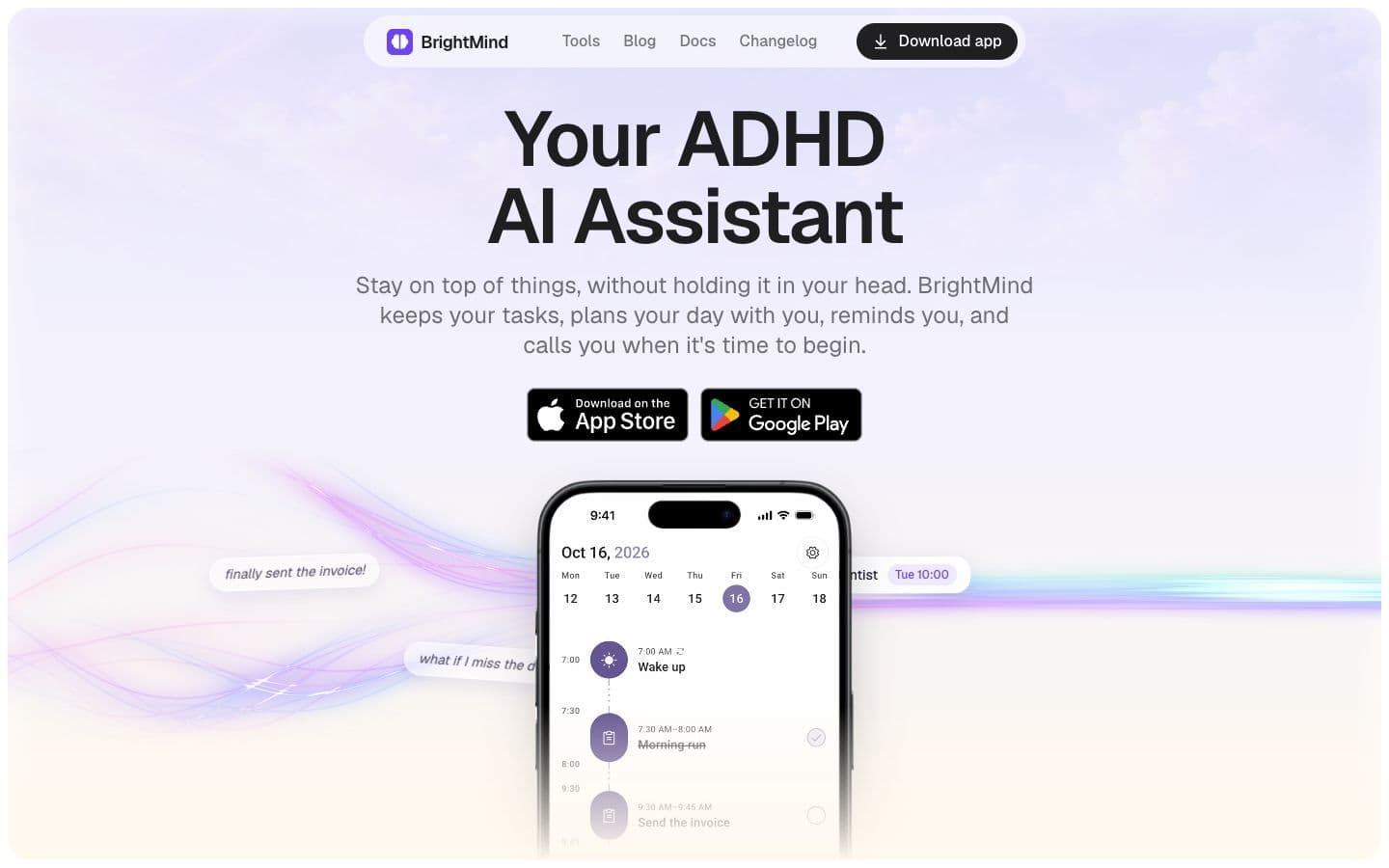 BrightMind homepage: "Your ADHD AI Assistant" with App Store and Google Play buttons above a phone showing a day timeline
The body doubling part is the call. BrightMind rings you as a voice call through the app at the time you said you'd begin, helps you pick the first step, and you can stay on the line while you get going, up to 15 minutes a call on Free or 60 on Plus. It's an AI on the other end, not a person, and I go through what that does and doesn't replicate in whether an AI can be your body double. The calling side has its own write-up in the app that calls you to check in, and if you're weighing it against chat tools like ChatGPT or Goblin Tools, our guide to AI assistants for ADHD sorts them by where you get stuck. It has its own task list and also connects to Todoist and TickTick, so the steps you commit to land in your task manager instead of evaporating. The free plan includes 100 messages and 30 minutes of calls a week. Plus, with 5 hours of calls a week, is $12.99 a month or $99.99 a year in the US; on iPhone both plans start with a one-week free trial, and on Android the trial comes with the yearly plan.
It fits people who freeze before they can even start, want something that talks them through it on their phone, and want the result saved to their task list. Being honest about the limit: it's an AI, not a person, so if a real human quietly expecting you is what moves you, Focusmate or Deepwrk will serve you better. It's built for the people who can't even get to that point, because starting is the wall.
Which body doubling app should you pick?
Pick by what kind of presence actually moves you, not by feature count. If a real person expecting you is what gets you going, start with Focusmate's free tier. If a group energizes you, try Deepwrk or Flow Club. If the hard part is starting at all, a tool that talks you through the freeze fits better.
Most body doubling services split the same way. Groups: Deepwrk, Flow Club, and Flown put a host and a room of people in one live session, with Deepwrk the one built specifically as an ADHD service. One-on-one: Focusmate pairs you with a single person. Phone apps: Dubbii uses live and recorded hosts, and BrightMind is an AI check-in call. Whatever shape you search for, the mechanism underneath is the same. And if presence isn't the gap at all, the best ADHD apps for adults list sorts the wider field, from task breakdown to time blindness, by the problem each one solves.
To test the idea for free, Focusmate's three-a-week and Flown's four-a-month let you try real body doubling for nothing. For the phone crowd who want a hosted room for chores, Dubbii is native and has a 3-day trial. Want an ADHD-first room? Deepwrk is built for exactly that. And when a stranger on video feels like more pressure, not less, you may want presence without an audience at all.
That last group is who BrightMind is for, and it's worth naming the honest limit of every app here. None of this works if the real problem is that you can't start, no matter who's in the room. If that sounds familiar, a quick, free ADHD self-screener and a read of ADHD paralysis, the freeze underneath all of this, will help more than picking the perfect room. A screener isn't a diagnosis, but it's a useful first data point.
Try one this week
Body doubling is one of the few ADHD strategies that's cheap to test and quick to feel. Most of the apps here cost nothing to try, so the only real risk is overthinking the choice instead of opening one. Pick the shape that matches your brain, run one session this week, and judge it by whether you started.
If your sticking point is the moment before the session, the not-being-able-to-begin, that's the gap BrightMind was built for. You talk, it calms the freeze, hands you one tiny step, and drops that step into BrightMind's own task list, or into Todoist or TickTick if you use them, so it doesn't vanish. Take a look, or grab Focusmate and a stranger on video. Either way, the move is the same: stop reading and start something small, with someone, today.
References
- Cleveland Clinic. (2025). What Is Body Doubling and How Does It Help ADHD? Cleveland Clinic Health Essentials. health.clevelandclinic.org
- CHADD (Children and Adults with Attention-Deficit/Hyperactivity Disorder). Could a Body Double Help You Increase Your Productivity? chadd.org
- Focusmate. Pricing and How It Works. focusmate.com
- Dubbii (ADHD Love). App Store Listing. apps.apple.com
- Dubbii (ADHD Love). Google Play Listing. play.google.com
- Flow Club. Pricing and Sessions. flow.club, and Help Center, on running sessions in the browser. help.flow.club
- Deepwrk. Pricing and Community Sessions. deepwrk.io
- Flown. Membership Options. help.flown.com, and FLOWN vs Flow Club pricing. flown.com
- StudyStream. Plans and daily focus room time limits. help.studystream.live
- Tan, V., Hegemann, K., & Gerken, J. (2026). A Roadmap of Mixed Reality Body Doubling for Adults with ADHD. arXiv preprint 2605.07851. arxiv.org
- Mohr, D. C., Cuijpers, P., & Lehman, K. (2011). Supportive accountability: A model for providing human support to enhance adherence to eHealth interventions. Journal of Medical Internet Research, 13(1), e30. PMC
- BrightMind Docs. Scheduled calls. brightmind.club
Frequently asked questions
- What is the best body doubling app for ADHD?
- There isn't one best app, because the right one depends on what kind of presence you need. Focusmate is the strongest free pick for live one-on-one sessions. Dubbii is cheap and works on your phone. Flow Club and Deepwrk run hosted group rooms. The best app is the one you'll actually open when you're stuck.
- Are there free body doubling apps?
- Yes. Focusmate gives you up to three live sessions a week for free, and Flown includes four community sessions a month plus Friday sessions on its free tier. BrightMind's free plan includes 30 minutes of calls a week. Dubbii, Flow Club and Deepwrk run on free trials rather than permanent free plans, so check each app's pricing before you commit.
- Is there a free body doubling website?
- Yes. Focusmate runs in your browser and gives you up to three live one-on-one sessions a week for free. Flown, also on the web, includes four community sessions a month on its free tier. For recorded presence, free 'study with me' and 'work with me' videos on YouTube work as a no-signup body double.
- How much does the Dubbii app cost?
- As of November 2026, Dubbii is free to download on iPhone, iPad and Android, and new eligible subscribers get a 3-day free trial. The US App Store lists two subscriptions, at $9.99 and $49.99, and Google Play shows in-app purchases from $9.99 to $49.99. There's no web version, so you get it from the App Store or Google Play.
- Is virtual body doubling as good as in-person?
- It depends on the person. The mechanism is the same either way: someone else's presence plus light accountability. In-person presence tends to feel strongest, but you can't always find a friend free at 9pm. Virtual sessions solve that. Some people need a body in the room, others get plenty from a muted video grid, so try both.
- Do body doubling apps actually work?
- For many people with ADHD they help, especially with starting, but the evidence is mostly clinical experience and user reports, not trials. Researchers describe the published work as a small number of papers. Another person's presence acts as external structure and accountability. It doesn't help everyone, so test a few free sessions on the tasks you freeze on most.
- Does BrightMind do body doubling?
- Yes, by phone. BrightMind is an AI assistant that rings you as a voice call through its app at the time you said you'd start, helps you pick a first step, and can stay on the call while you begin. The other side is an AI, not a person. The free plan includes 30 minutes of calls a week.
- What is virtual body doubling?
- Virtual body doubling is doing your task alongside someone over video or audio instead of in the same room. You both work on your own things, often with a quick check-in at the start and end. The other person's presence creates accountability and structure, which is the part of body doubling that actually does the work.